
The sun has set, campfires crackle in nearby campgrounds, and the last glow of daylight fades from the Topatopa Mountains. As the evening air cools, hikers make their way back to the trailhead, and the Ojai Valley settles into evening. Once our preserves close for the night, they become something different: a quiet space where wildlife can move undisturbed until dawn. Nights have a way of revealing what daylight often keeps hidden, and this month we’re giving you a glimpse into that hidden world. Do you ever wonder what critters are out lurking after dark? We’re excited to acquaint you with a few nocturnal creatures that could scurry across your moonshadow. This month’s creature feature is dedicated to one of the best parts of summer in Ojai: the cooler nights.
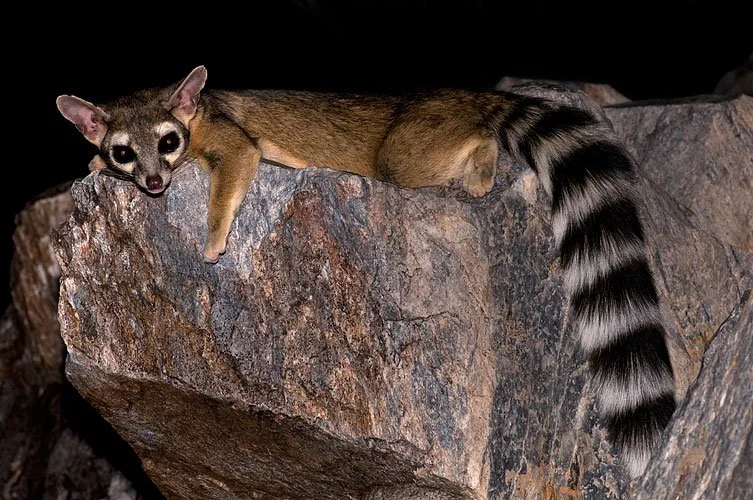
Ringtail (Bassariscus astutus). Photo by Robert Body
RINGTAIL (BASSARISCUS ASTUTUS)
As the daylight fades, an entirely different side of the Ojai Valley begins to wake. Among its most elusive nighttime residents is the ringtail (Bassariscus astutus). Despite their cat-like appearance, ringtails are actually the smallest members of the raccoon family (Procyonidae). These secretive, almost exclusively nocturnal mammals spend their nights navigating rocky canyons, oak woodlands, and riparian corridors in search of insects, small mammals, birds, and seasonal fruits to munch on. Their long, black-and-white striped tail provides exceptional balance as they scramble across narrow ledges and jump between tree branches. They can even rotate their hind feet nearly 180 degrees, allowing them to descend rocky cliffs and trees headfirst with remarkable agility.
Protected in California since 1927, ringtails continue to find refuge in the rugged landscapes of the Ojai Valley, highlighting the importance of conserving the wild places they call home. For most of us, their presence is often only known through tracks, scat, and the occasional wildlife camera capture. While they are seldom seen, they’re far from alone after dark. Dusky-footed woodrats emerge from their stick-built dens, gray foxes silently patrol the understory, and countless other creatures are out enjoying the moonglow.
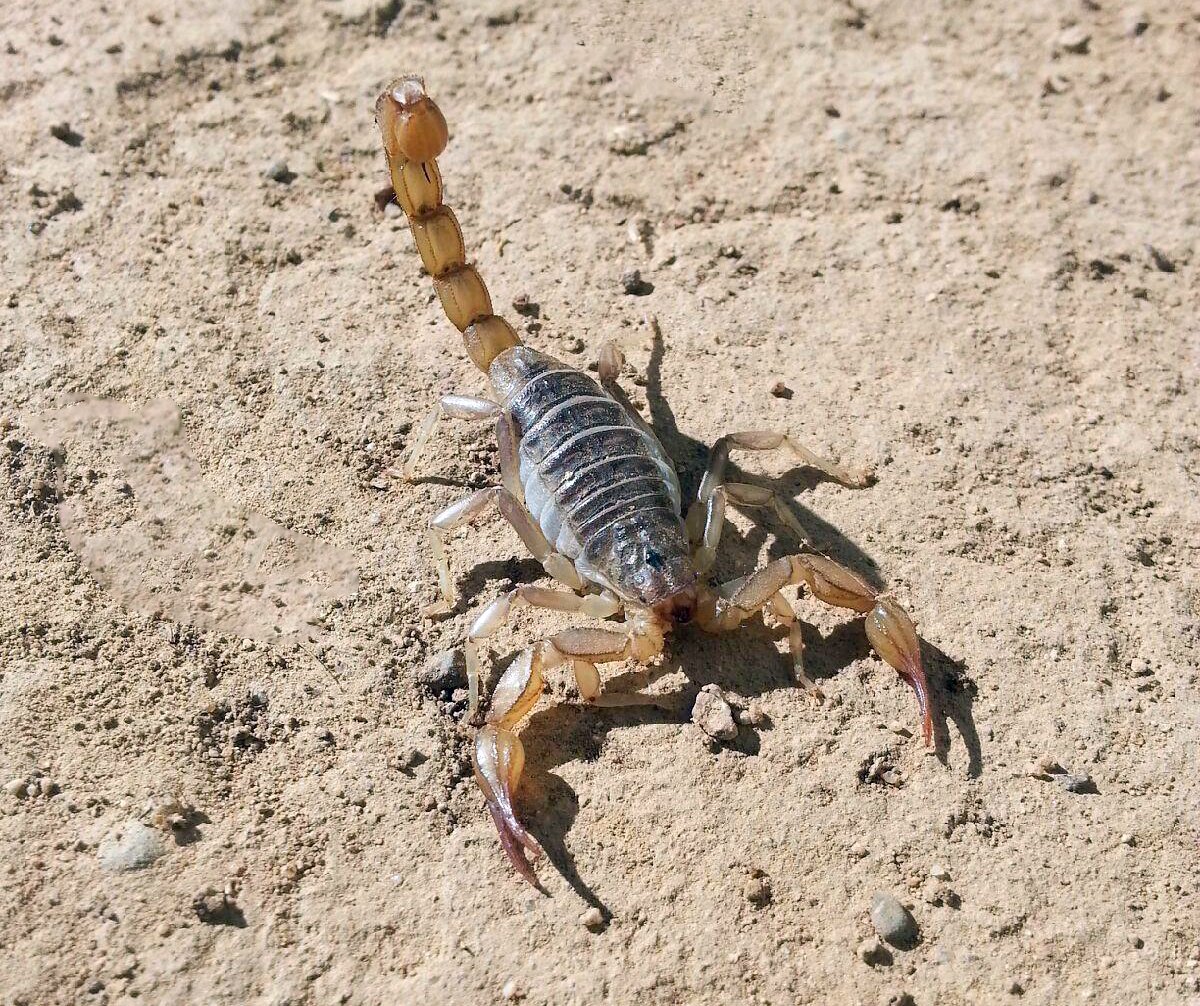
California Common Scorpion (Paruroctonus silvestrii). Photo by Nathan Wickstrum
CALIFORNIA COMMON SCORPION (PARUROCTONUS SILVESTRII)
Another critter that often goes unnoticed due to its reclusive nature is the California common scorpion (Paruroctonus silvestrii) also known as the stripe-tailed scorpion. Typically a gray-brown coloration, they can also have a mottled reddish appearance with stripes on the tail, hence its common name. Scorpions also give birth to live young! They’ll carry their babies on their backs until their first molt, where they’ll be forced to leave the burrow and go out on their own.
Native to the coast of California, this arachnid spends most of its day hiding from predators in arid, alluvial environments including coastal sage scrub, chaparral, desert scrub, and sandy coastal areas underneath rocks or in its burrow. Some of their predators include other arachnids, reptiles, and some mammals. In the Ojai Valley, the Greater Roadrunner (Geococcyx californianus) actively hunts the California common scorpion, manipulating its prey with precision to avoid envenomation before consuming it whole.
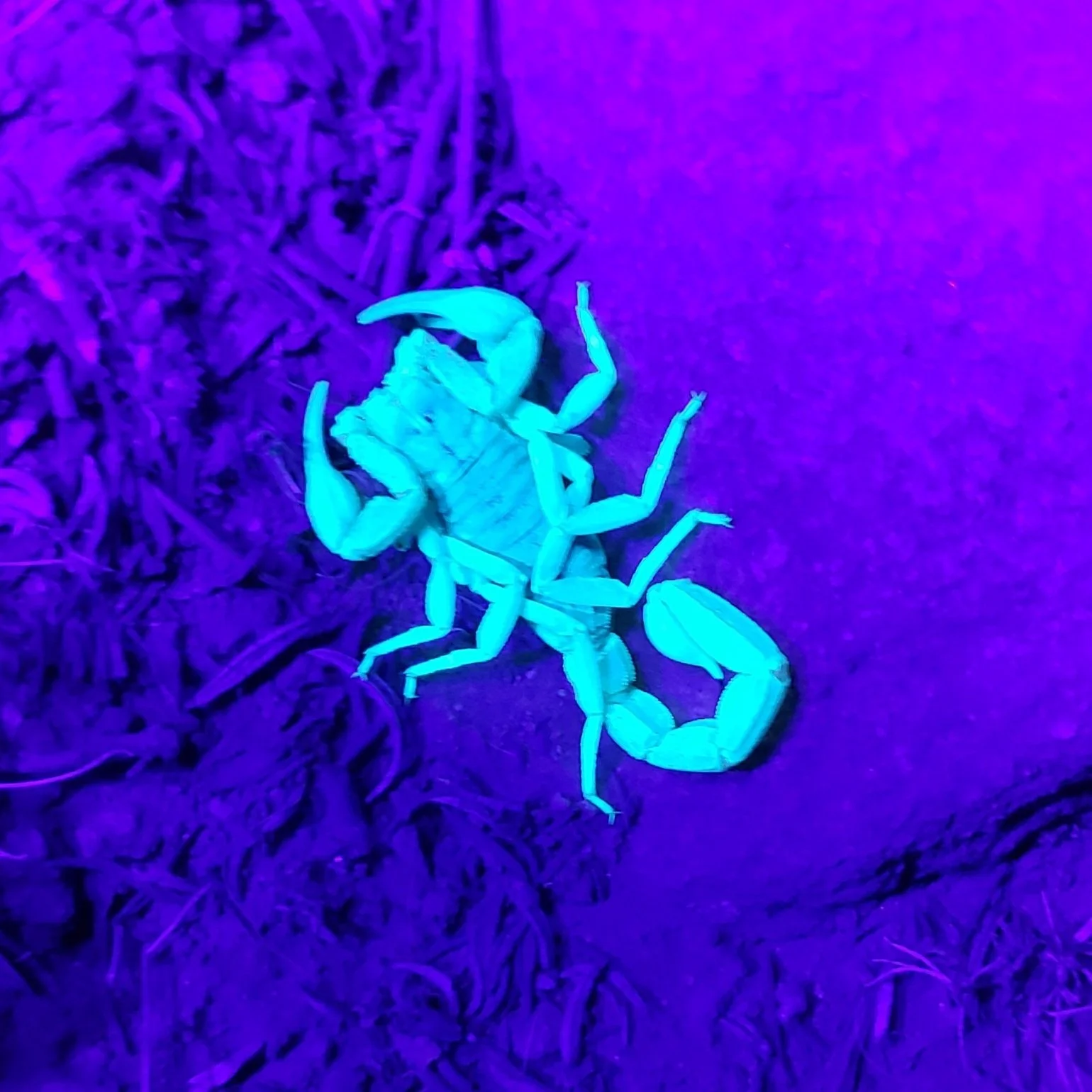
California Common Scorpion under ultraviolet light. Photo by Elizabeth Praetz
Come nightfall, this nocturnal animal emerges for the night to feast on small invertebrates. Insects, spiders, and even other scorpions are among the few prey items on the scorpions pallet. Instead of using sight to locate prey, the scorpion uses its sensory organs. Setae, bristly sensory hairs located over the dorsal surfaces of the body, sense ground vibrations and use pectines that detect chemical cues. Clutching its victim with its long and slender pedipalps, it uses its stinger to deliver a powerful and paralyzing sting before consumption. While they are venomous, they pose little threat to humans, and their sting is comparable to a beesting. A striking trait of this scorpion species is that it fluoresces under ultraviolet light. Some studies show the scorpion’s ultraviolet glow might be used as a predator deterrence, and a potential hunting aid. Alternatively, some scientists also believe it may inadvertently aid other nocturnal hunters that can pick out their inflorescence. All theories are still up for debate.
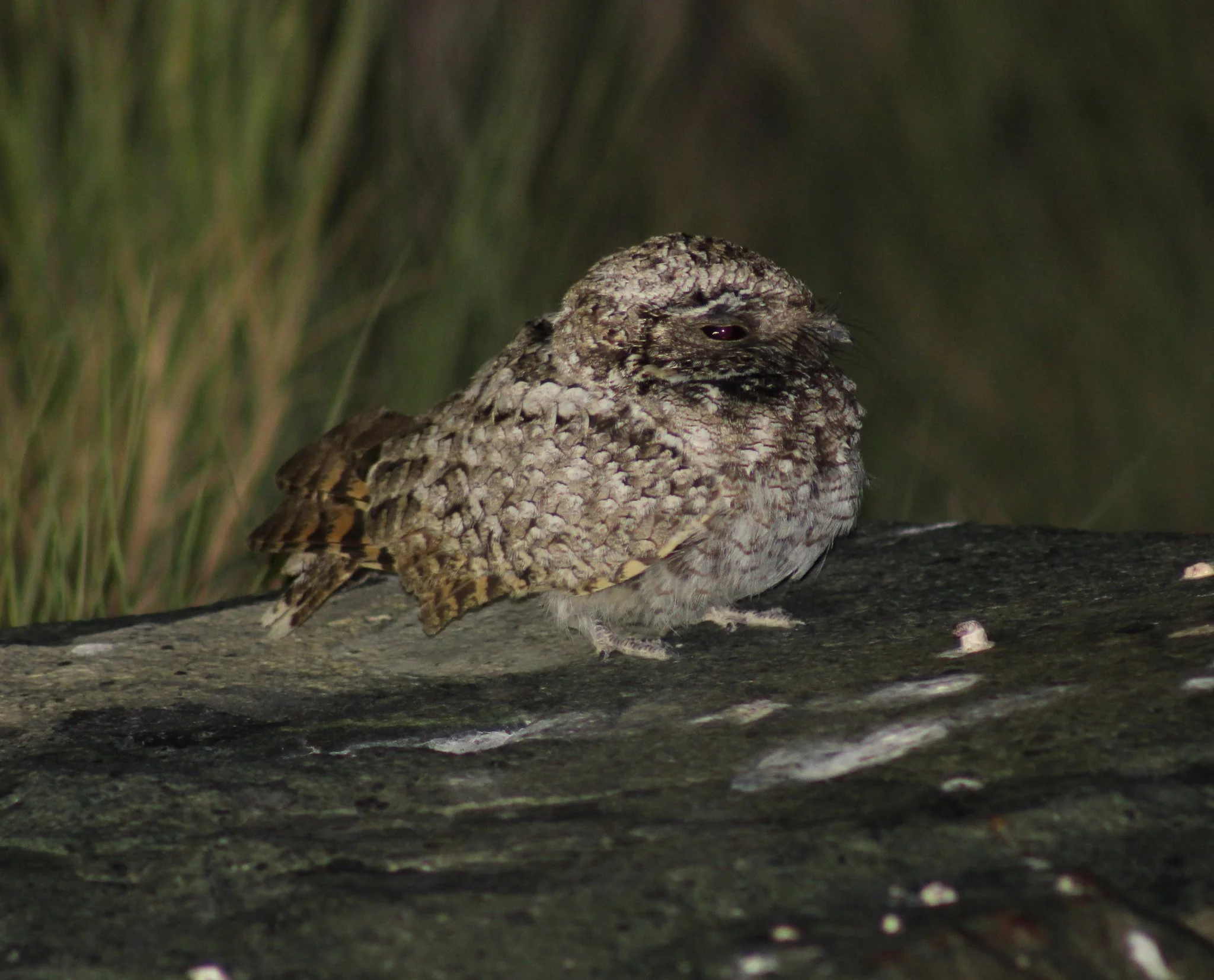
Common Poorwill (Phalaenoptilus nuttallii). Photo by Wendy St. John
COMMON POORWILL (PHALAENOPTILUS NUTTALLII) & LESSER NIGHTHAWK (CHORDEILES ACUTIPENNIS)
You are more likely to have heard the ominous songs of these nightbirds than you are to have heard their names. Let me introduce you to the nightjars of Ojai, the Common Poorwill (Phalaenoptilus nuttallii) and the Lesser Nighthawk (Chordeiles acutipennis). All birds in the nightjar (Caprimulgidae) family are fully nocturnal and feed strictly on insects. This unique style of living gives nightjars a very characteristic look. They are united by having large dark eyes that help them see in dim light, incredibly wide gapes for swallowing insects midair, and very cryptic coloration for blending in by day. They also often have tactile-sensing “whiskers” around their beaks known as rictal bristles that help them hunt in the dark.
While they are very similar, the Common Poorwill and the Lesser Nighthawk have a few key differences in habit that allow them to coexist. The poorwill uses a “sit and wait” strategy, waiting patiently on patches of bare ground with a clear view of the night sky to watch for approaching insects. They will leap into the air only when their prey gets close enough, quickly returning to the ground. The nighthawks, on the other hand, are more active hunters, chasing after swarming insects a few feet above the ground. Also, the nighthawks are most active at dawn and dusk, while the poorwills are active throughout the night. You are more likely to tell them apart in their habits or in their songs than by their appearance, but one key visual difference between the two is that the Common Poorwill has those whisker-like rictal bristles around its beak, while the Lesser Nighthawk does not. If you hear a call that sounds like gurgled laughter darting through the air at dusk, you are likely encountering a nighthawk. On the other hand, the poorwill will likely emit its rhythmic, two-toned whistle from a stationary point, tucked away amongst the chaparral.
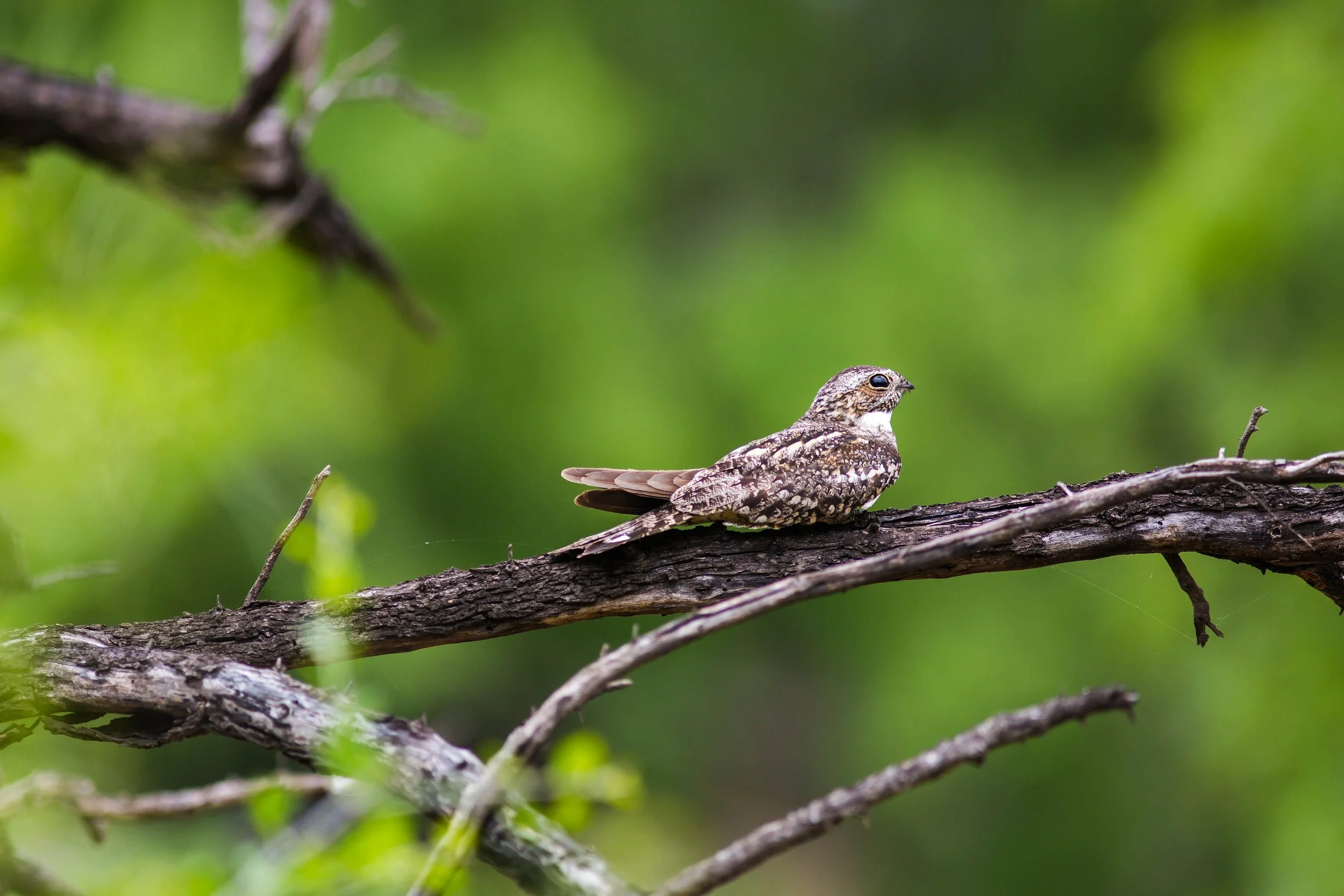
Lesser Nighthawk (Chordeiles acutipennis). Photo by Melissa McMasters
Summer nights offer more than just cooler temperatures. They offer a chance to see the Ojai Valley from a completely different perspective. For many of the species you’ve just met, life after dark isn’t a coincidence; it’s a survival strategy. Existing in the cooler evening temperatures minimizes their encounters with predators, conserves their body water content and energy by avoiding extreme heat, and helps avoid food competition with other animals. By protecting and restoring the habitats these animals depend on, we ensure this hidden world continues to thrive. The next time you’re out exploring, look a little closer. You never know what incredible wildlife might be sharing the trail with you.
Caden Crawford, Emma Gibson & Kiandra Kormos