
HOW TO MOVE A BEHEMOTH: STONE AGE SKILLS FOR MODERN TRAIL BUILDERS
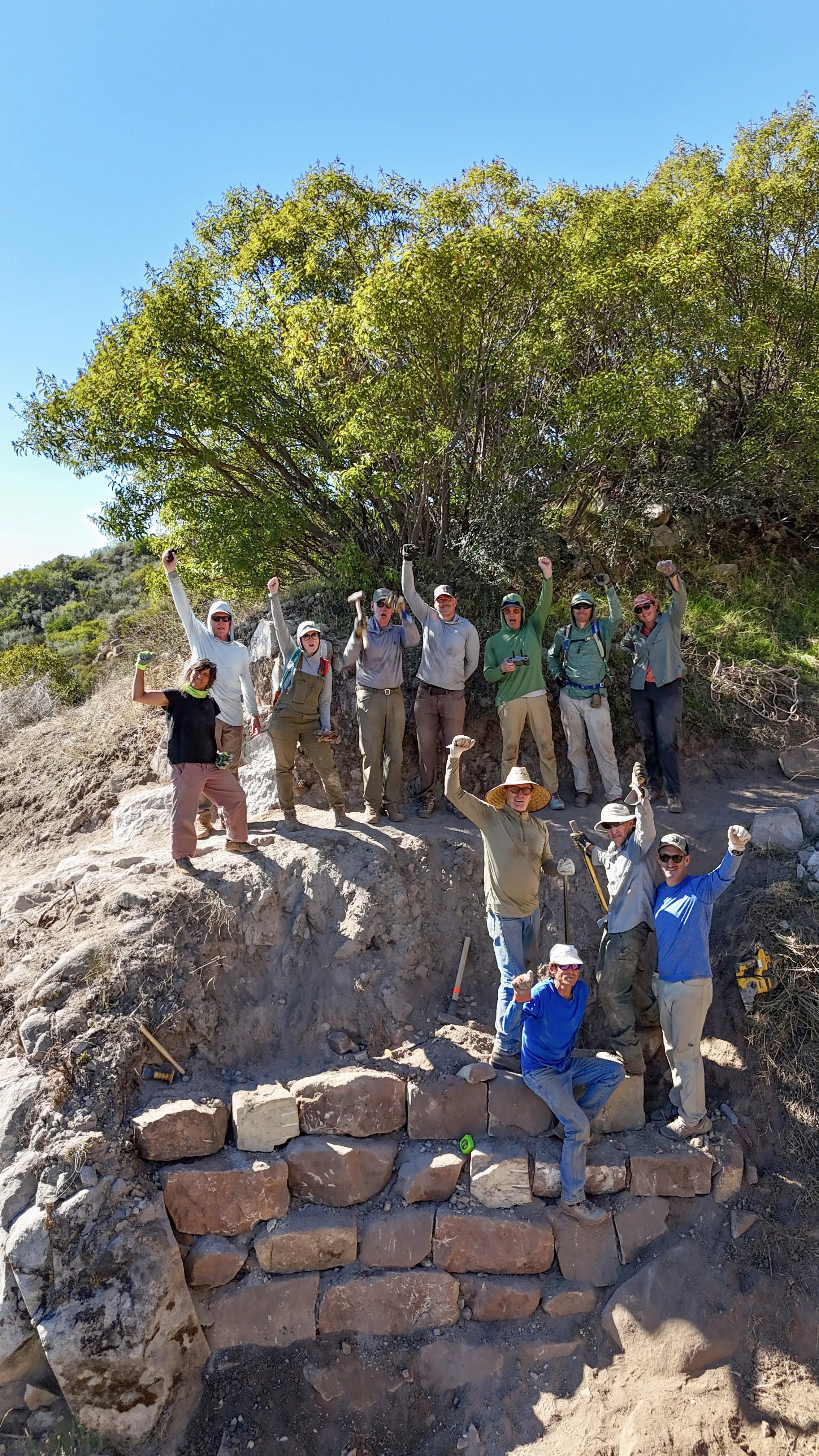
A rock-solid crew at Valley View Preserve celebrates progress on the new retaining wall along John’s Fox Canyon Trail. Photos by Anthony Avildsen and OVLC Staff
At first, moving rocks feels like being a Stone Age human: no words, just grunting and groaning as you jab your rock bar aimlessly at the burdensome behemoth before you, trying to get it to budge. But slowly, an understanding dawns on you, and you realize that your exhaustingly heavy steel bar is a kind of seesaw plank, with you on one end and the behemoth on the other. This revelation gets you talking with your rock-rolling partners, guessing back and forth about where to wedge the bar beneath the behemoth, whether to lever up with a fulcrum, or which corner to row the rock with—and on and on. You blabber through it, struggling to find the right words to make this demanding task a little less impossible. But as the rock begins to roll, precision increases. Movements become easier to predict, placement and leverage more accurate. Before long, you’re back to barely speaking—because now you and your partners are in sync, turning the behemoth as if it were a wheel: the rock the hub, your bars the spokes, and you the force turning it round and round.
Now you’ve rolled the rock to its destination and plopped it into the hole you dug. But this rock is no smooth monolith—it’s knobby, ridged, divoted, and rounded in all the wrong places. The behemoth wobbles inscrutably, and you’re back to groaning. Try an Irish jig on its surface—really get it rocking— and see if you can sense the knobby thimble it’s improbably teetering on. Once you pinpoint the offending spot, it’s time for a soliloquy: a plea for the rock to just sit still. To shim is a shame, so you can’t just toss smaller pebbles under your behemoth like napkins under a short table leg.
Back to talking it out, then—finding the right words to describe what you can no longer see: the rock’s underside and how it sits in its hollow. Maybe if you could just rock it like a baby—scoop the bottom up while tilting the top back—it might settle down? Of course, in the hills of Ojai, it’s mostly coldwater sandstone, weighing about 150 pounds per cubic foot, so simply yanking it out is easier said than done. Alas, you’ll have to wiggle it around in the hole, being extra careful not to collapse the dirt walls and turn your tidy pit into a crater that can’t catch the rock at all. Groaning once more, you use surprisingly soft, delicate maneuvers to coax this hard rock into just the right spot.
Lo and behold—after much exasperation—you find just the right fulcrum: flat enough to fit the narrow void between your wall and the rock, but not so thin that it disintegrates under pressure. The rock catches without any roll! That only took a couple of hours for one rock—not bad! Now do it dozens and dozens of times...
That’s the challenge our volunteers face this fall. Across the valley, they’re building rock structures on trails. At the Ojai Meadows Preserve, volunteers are constructing steps through the pond drainage; on the Valley View Preserve, they’ve begun a large retaining wall to shore up John’s Fox Canyon Trail. Preserve users have been thrilled—those new steps at Ojai Meadows Preserve might be the most popular trail feature we’ve ever built. After the mid-October rains, hikers got to test them out, and many were astonished by how much work goes into moving each stone. So were a few of our volunteers—especially the new ones.
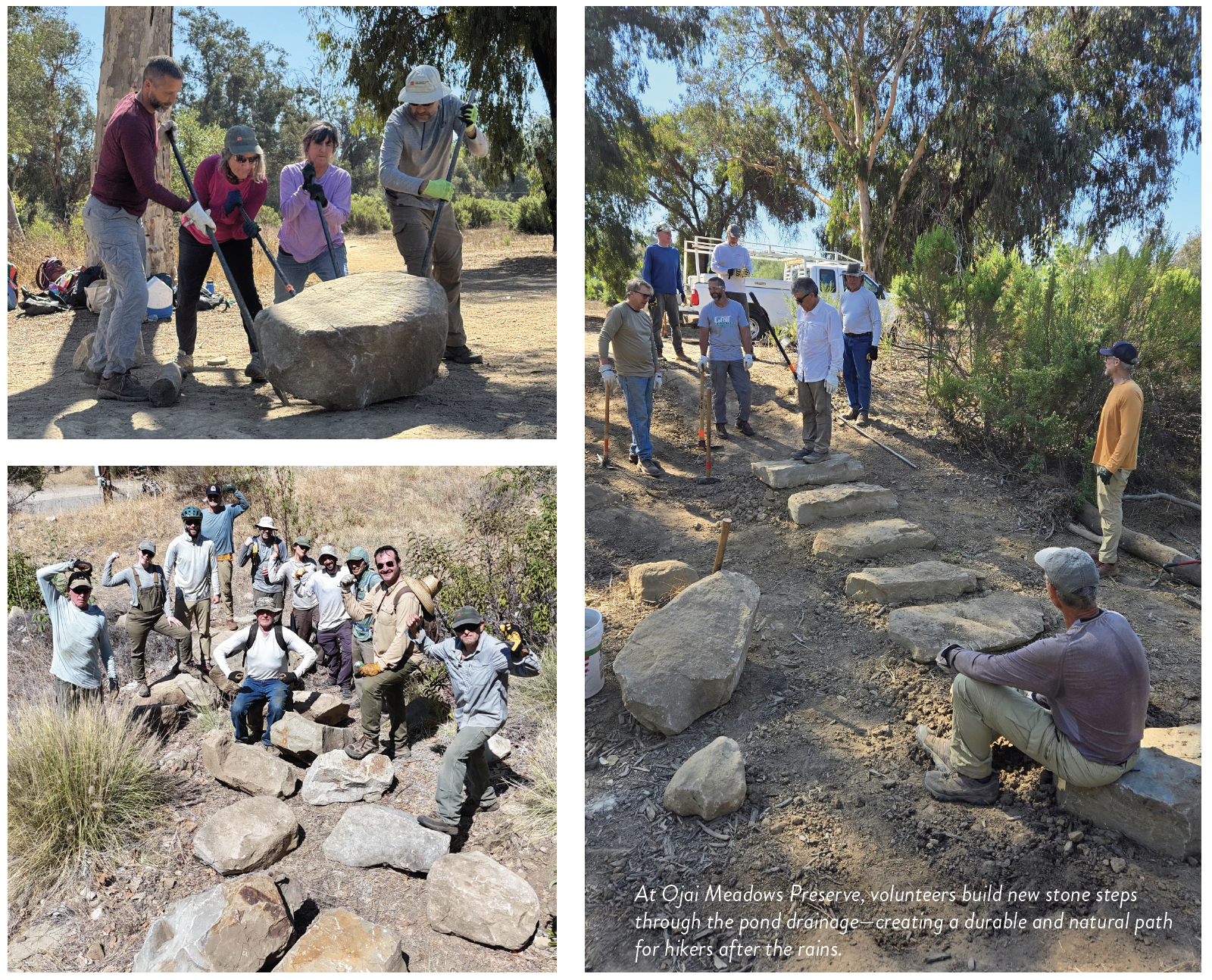
At Ojai Meadows Preserve, volunteers build new stone steps through the pond drainage—creating a durable and natural path for hikers after the rains.
It might take only seconds to walk past a retaining wall or climb a flight of stone steps, but it’ll take our volunteer program until the end of the year to finish these projects. That’s perfectly fine—doing this work by hand isn’t just necessary (especially on the steep slopes of Valley View); it’s rewarding. Confidence grows as we move through that bell curve of communication—from grunting, to fumbling for the right words, to finally working in seamless rhythm where only “Got it” and “Free” are needed. Creativity flourishes as we figure out how to move behemoths with nothing but hand tools and slings. Craftsmanship sharpens too, since we use dry-stone masonry—no cement, just precision and care.
Despite the time and frustration, these structures are durable. The sandstone is about 40 million years old, give or take, so we can reasonably expect a few decades out of our handiwork. Best of all, the rock belongs here—it looks right at home on our trails. At first, working with rock might seem daunting, but it’s an adventure. So even if you’ve never volunteered on trails before but want to evolve your skills, sign up at ovlc.org/volunteer and join us this winter!
Brendan Taylor, Director of Field Programs