
STEWARDING THE STREAMS: RIPARIAN RESTORATION IN THE VENTURA RIVER WATERSHED
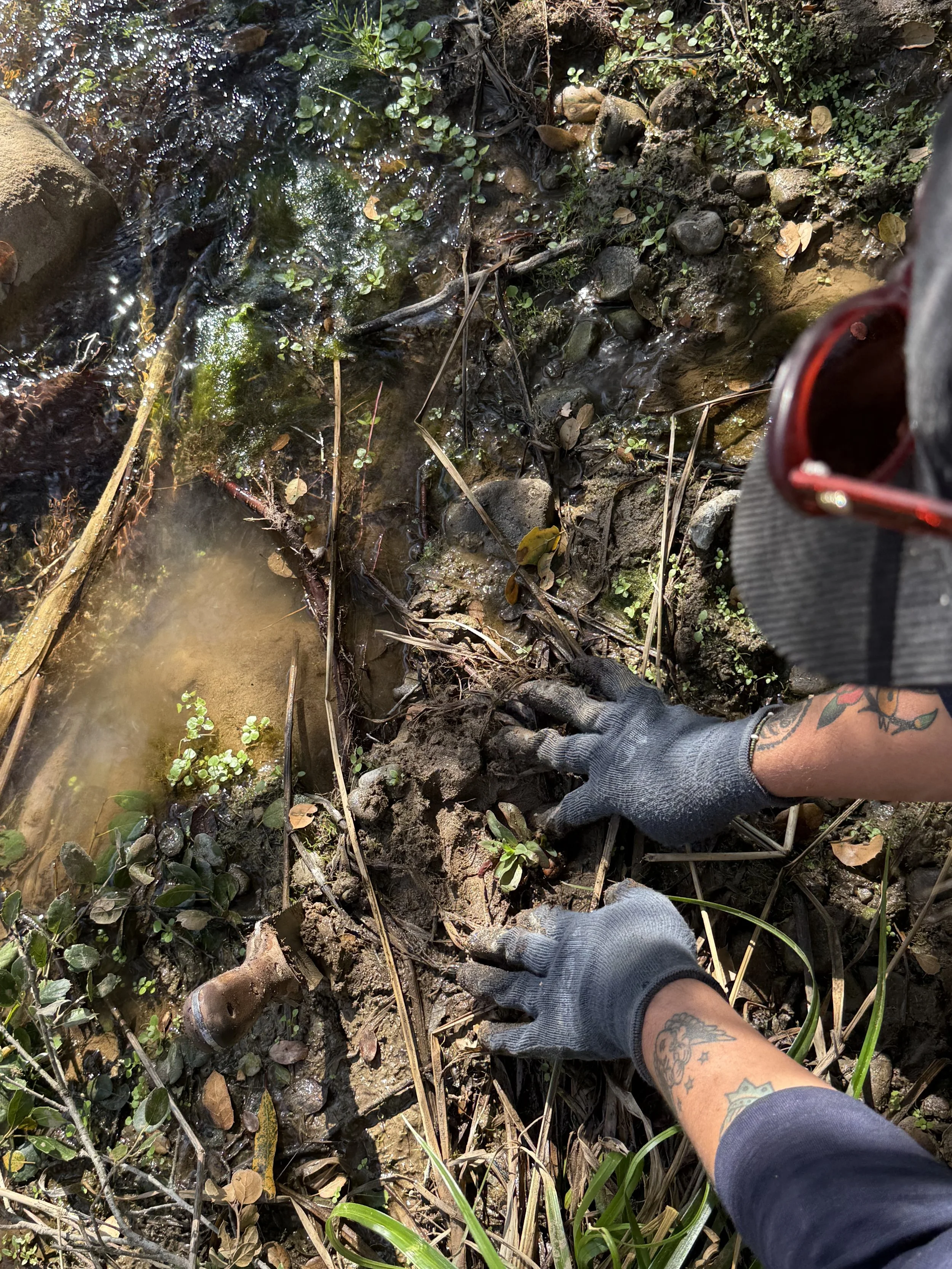
ARUNDO WRAP-UP & WHAT WE ACCOMPLISHED THIS YEAR
While our restoration team spends the summers in willow thickets and alluvial scrub, we dream of a watershed that is freed of the clutches of invasive species. Intentions are set as our calloused feet traverse Eocene cobbles, our dainty palms gather seed, and soft conversation is found muffled by flume. We quickly find that it is not a unique dream, rather one of unquantifiable spirits within our valley, from translucent benthic macroinvertebrates to our neighbors in the community. This realization brings a blanket of hope, of trust and power, that we all crave a nourished watershed, one well taken care of, so that in turn our ecosystem can nourish all. With fiery eyes, we set out determined.
OVLC recognizes that the efforts of ecological healing made throughout our valley are of magnitude greater when made together. We know that most of you reading this very article are engaging with your properties in creative, restorative ways.
Keep going. This movement, the re-establishment and preservation of biodiversity, relies on us all. Acting in unison and collaboration is one of the most beloved roles we have as leaders of climate resiliency in the valley. We ache for connection, for the kind moments of getting to know the folks who make this valley special. This past fall, we were grateful to engage with the community as we underwent our largest invasive species removal undertaking to date.
From September through January, we cleared invasive species from 226 acres of land. Of which, 35 acres were solely giant reed (Arundo donax). Over 25 noxious species removal specialists were working every day, battling infestations of non-native plants on over 20 privately owned parcels in the watershed. Our work here has just begun, and we need your help to bring nature home!
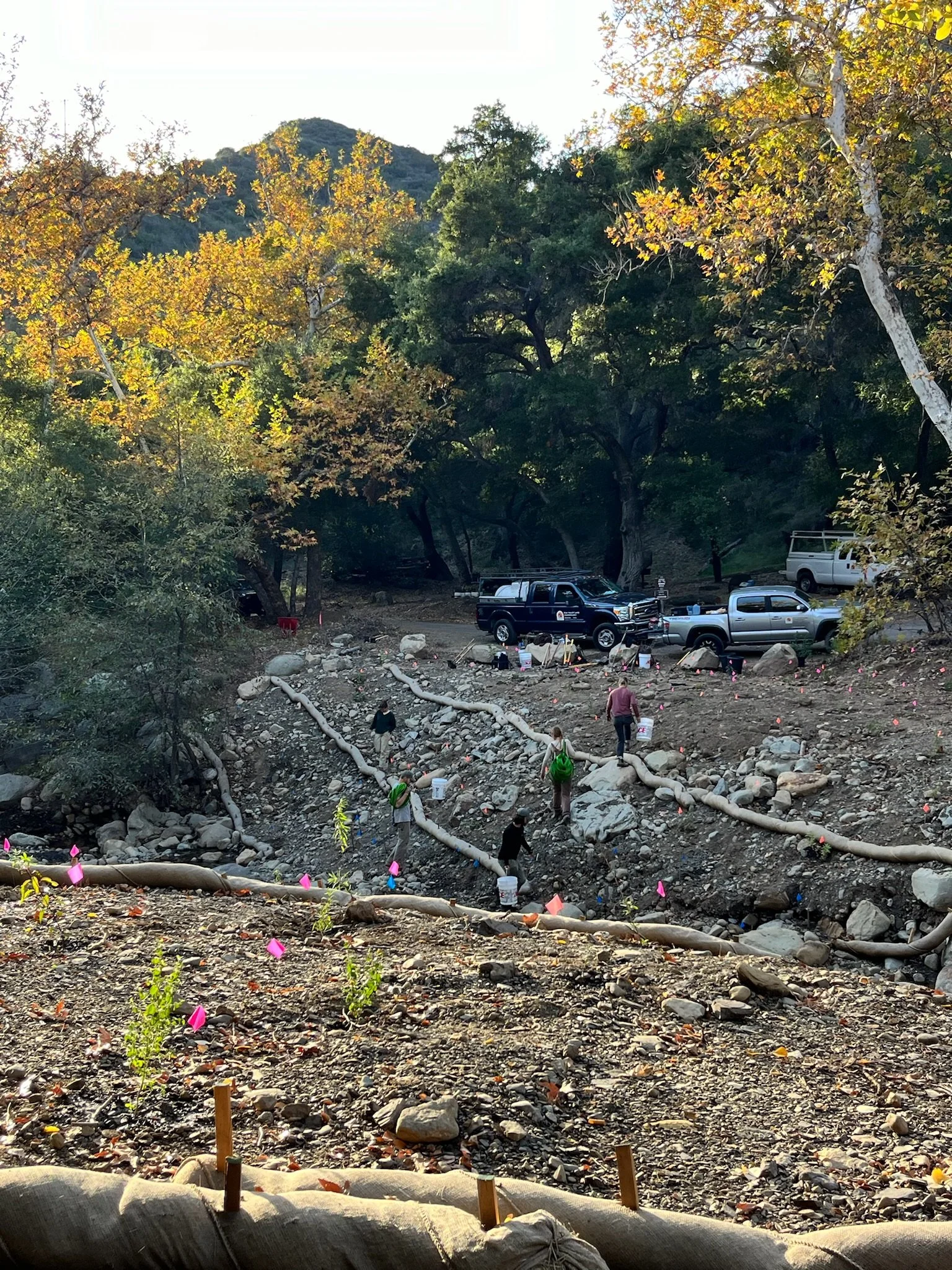
OVLC’s restoration team planted native vegetation along the North Fork of Matilija Creek after bridges replaced old crossings at Wheeler Gorge Campground—reopening habitat for steelhead.
RESTORATION GOALS & WHY IT MATTERS TO REVEGETATE NATIVELY
The goal of our restoration work is to return ecosystem strength and function after domination by arundo. Most of you know by now that there are very few native species that can co-exist with arundo, plants or animals. Riparian zones, being a hub for our fine feathered friends, are usually lively and engrossed in a beautifully complicated song. Yet dense stands of arundo are often marked by an unsettling silence. Where arundo persists, nothing else exists. That said, when it is removed, all that is left is bare ground, degraded soil, and and a depleted native seed bank.. If we don’t actively revegetate after removal, the site is highly vulnerable to colonization by other invasive species.
Revegetating with native plants helps provide resilience against future disturbance. The presence of native species that have had a head start in our nursery helps resist invasives, in part, by simply taking up space. They utilize limited resources like space, sunlight, and minerals, leaving less for the non-native plants. Native roots help knit together the soil, restabilizing the flood zone. They also help rebuild the soil ecology, which in turn encourages more native recruitment. It is such a treat to watch this magic unfold in the field. When you lend nature a hand, she quickly takes hold and moves forward in leaps and bounds.
Native vegetation also provides habitat and nourishment for our local fauna. For example, many native insects have mutualisms with native plants and will struggle or even cease to exist in their absence. While OVLC doesn’t conduct insect surveys, we do recognize the return of insectivorous birds in areas we have restored, which is an excellent indicator of the importance of our work. The native trees and shrubs that we return to our alluvial zones provide food and shelter for an abundance of critters beyond insects, but we’ll get more into that later. It feels a lot like a paint by numbers piece, we choose plant species and densities by studying and mimicking intact riparian woodlands nearby. Nature has already given us the outline; we are simply filling the gaps left by arundo and restoring color to the
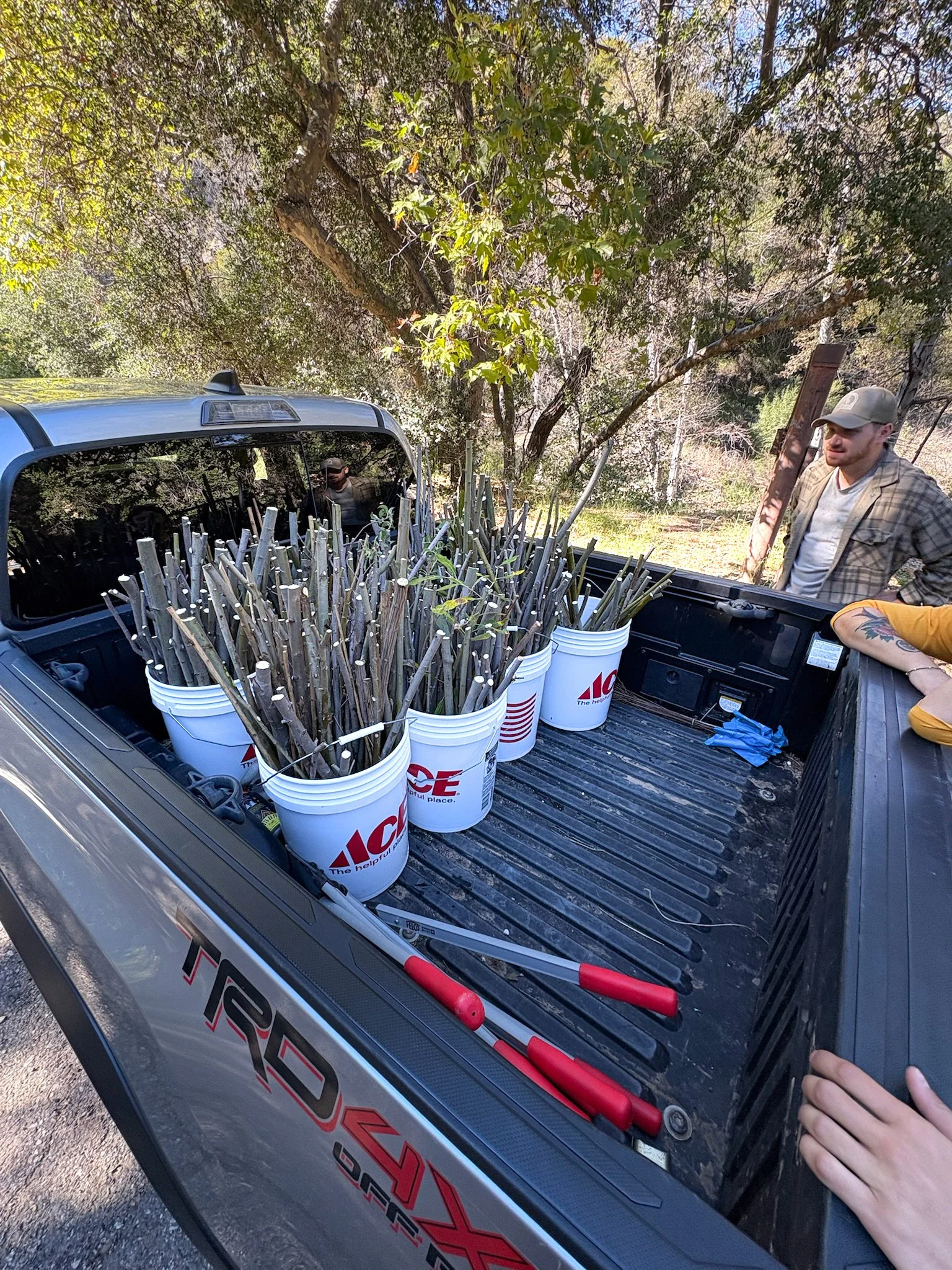
Willow and mule fat cuttings
STEPS WE ARE ACTIVELY TAKING.WHAT IS THE FIELD CREW UP TO?
Down along San Antonio Creek and the Ventura River, our work has shifted from removal to renewal. Following invasive weed treatments, as the pressure eases, we begin restoring what belongs. Native plants are beginning to return, and we are there to give the land a helping hand.
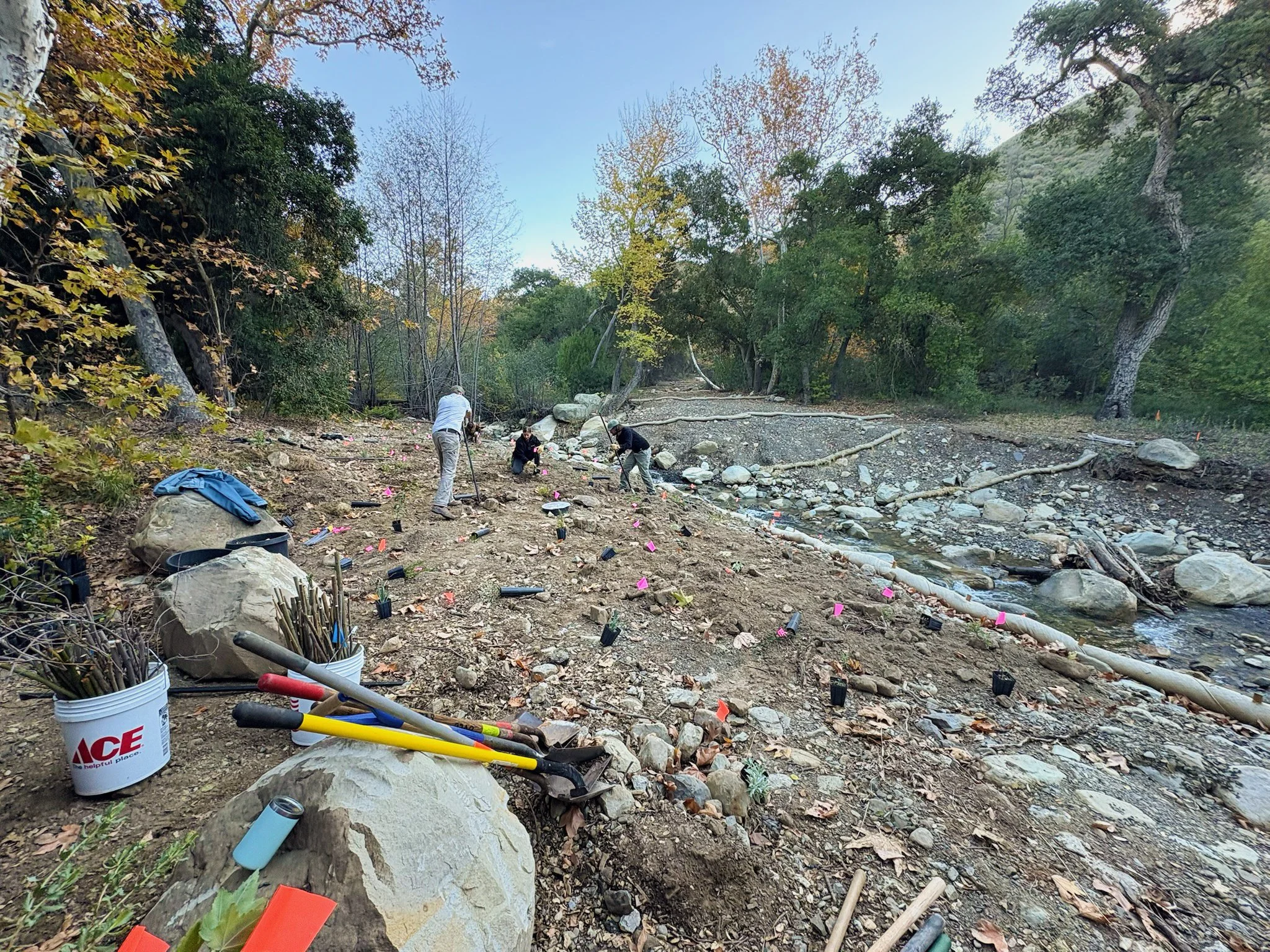
Winter rains provide the best conditions for planting, and this season we have installed over 3,000 native plants and stakes across these sites. Much of our time is spent driving in willow and mule fat cuttings “stakes” into moist streamside soils, knowing they will root quickly and begin stitching the banks back together. Within the stream’s margins, we sow cocklebur (Xanthium strumarium) seeds, install knotgrass (Paspalum distichum) stolons, and plant willowherb (Epilobium ciliatum).
In transition areas, we are planting a mix of grasses and shrubs, chosen to reflect the reference vegetation community. Species like California rose (Rosa californica), creeping and giant wild rye (Elymus triticoides, Elymus condensatus), mugwort (Artemisia douglasiana), and sage (Salvia spp.), to name a few, help rebuild layers of habitat over time. Planting, however, is only the beginning.
We return again and again to buffer invasive regrowth, giving young natives the space to root deeply and claim their place along the banks. We watch closely as the landscape begins to shift, revisiting photo points to witness the transformation and conducting bird and reptile and amphibian (herp) surveys to see who has answered the call of returning habitat.
Over time, these photo comparisons allow us to track canopy development, groundcover expansion, and improved bank stability along the floodplain margins. The return of insectivorous birds and increased herp activity serve as early indicators that structural complexity within the riparian corridor is being restored.
As these plants settle in and life begins to stir around them, the creek moves steadily toward the resilient, nourished watershed we all long to see.
FUTURE LIFE. WHAT WILDLIFE AND HABITATS WILL BE RETURNING?
So, what’s next? With the arundo stands removed, it leaves critical space that biological communities desperately need to expand, and thrive. Throughout the watershed, we’ve identified various plant communities that we hope to encourage to re-establish.
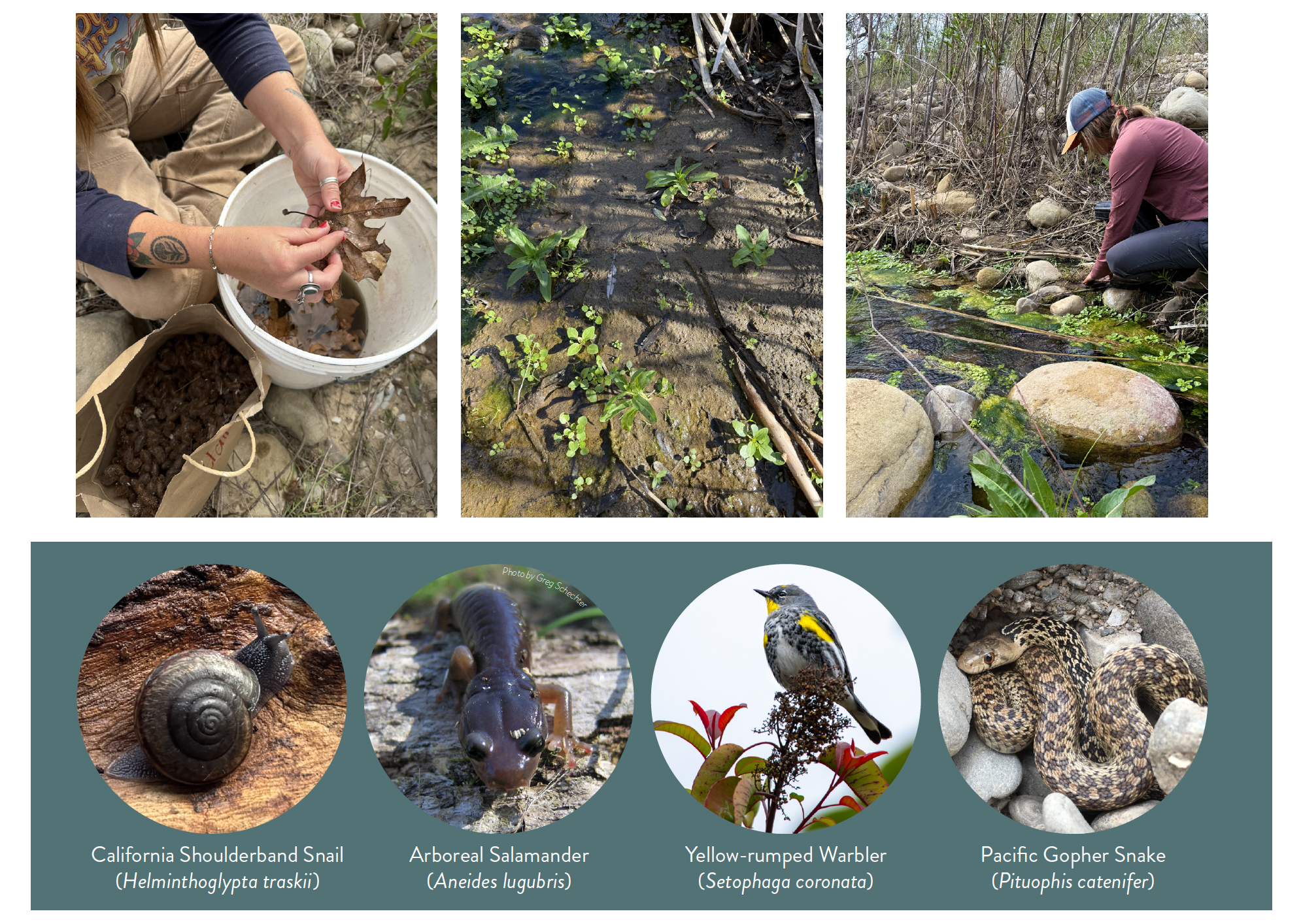
During our active restorations, we’ve encountered numerous microclimates, each unique with their vegetation communities, each with their own distinctive species palette. Upstream from Camp Comfort, beautiful old-growth forests nestle along the sandy banks of San Antonio Creek, teeming with animals and fungi alike. To name a few, we discovered an incredible amount of southern California shoulderband snails (Helminthoglypta traskii), emerging from their leafy hides during evening rainfall in search of a fungus feast. Scattered throughout this reach, we noticed fungal caps poking out of the leaf litter in various colors, shapes, and sizes. Mushrooms are not only a treat to find, but a large mycelial network is a huge indicator of a healthy riparian woodland. These moisture-rich riparian woodlands support another elusive species that we hope to promote a thriving habitat for, the arboreal salamander (Aneides lugubris). Arboreal salamanders are unique in their preference for nooks and calluses of old growth riparian trees, often sycamores or oaks. When we think of success in our restoration areas, we envision them everywhere. These critters, along with many other wildlife species, are insectivores, meaning they depend on a slew of insects to survive. Re-establishing our biological communities restores the food web, from the smallest biota to the resplendent species we know and love.
Recently, we’re already starting to see an increase in pollinator activity in our native willow and mulefat thicket communities as their buds start to swell and bloom. This was very exciting to see, not only because our keystone species pollinators help hold ecosystems together by supporting plant reproduction and plant diversity, but with an uptick in insect pollinator activity means…birds! To highlight some, we’ve observed large bouquets of Yellow-rumped Warblers (Setophaga coronata), hunting throughout the willow and mulefat thickets and into the surrounding alluvial scrub, searching for a buzzing snack. Another bird species we have recognized scratching through our blossoming alluvial scrub community is the California Towhee (Melozone crissalis). These birds are mostly ground foragers, hunting through the sandy, rocky surface for insects such as our native ant species, grasshoppers, beetles etc. These ecosystems support frugivorous birds as well, like the Cedar Waxwing (Bombycilla cedrorum), who scour through our coast live oak riparian habitat in search of our blue elderberry (Sambucus nigra ssp. caerulea), toyon (Heteromeles arbutifolia) as well as from our Pacific poison oak (Toxicodendron diversilobum), whose fragrant blooms and ripe berries are just beginning to show off.
Slightly upland, within our newly established sagebrush and chaparral plant communities, scuttle other, less-feathery animal species. Cold blooded critters such as snakes and lizards take residence in burrows and dark hide-aways among the bushy sage scrub, in search of small rodents and insects. One of the most commonly seen animals in our sage scrub and chaparral is the Pacific gopher snake (Pituophis catenifer), which feeds on gophers, mice, squirrels, and rats, including the dusky-footed woodrat (Neotoma fuscipes), an important keystone species in this ecosystem.
All of our plant communities and animal species rely heavily on the flow of the other. As a restoration team, we’re curious about every interaction in nature, and are striving to restore that flow back into the ecosystem. If you’re ever interested in spending time among our natural environments, come volunteer with us, learn with us, and help us restore what once was.