
MEET THIS YEAR’S WSP CORPSMEMBERS

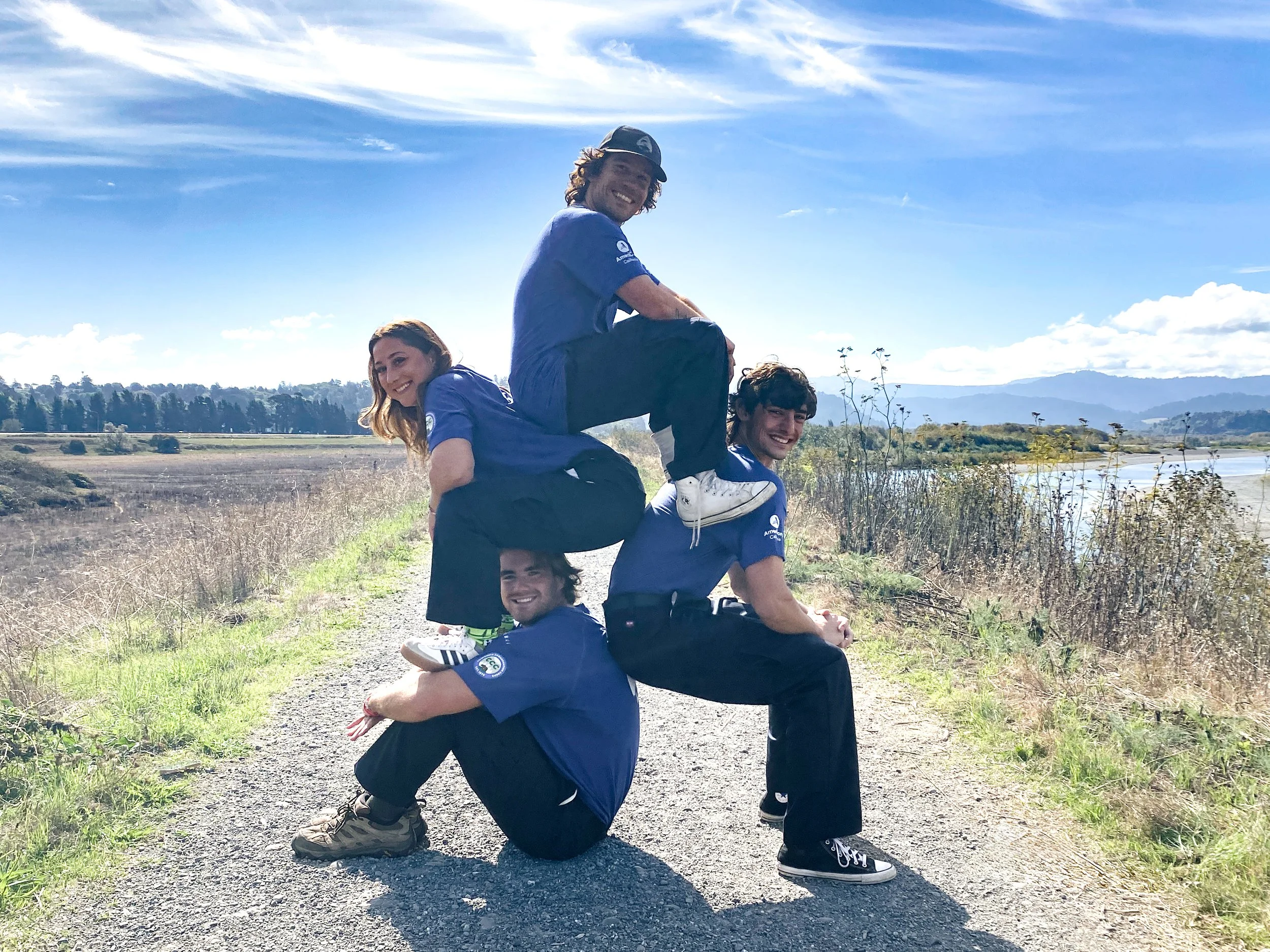
This year’s WSP Corpsmembers (left to right): Dylan Hansen, Owen Sobel, Summer Seligmann, and Alex Dixon.
WHAT IS WSP?
Each year, OVLC and CDFW Santa Barbara host and mentor four Watershed Stewards Program (WSP) Corpsmembers for their 10.5-month service term. WSP is a program of both the California Conservation Corps and AmeriCorps that places young professionals with mentors at placement sites across the state to gain experience in fisheries work, watershed science, environmental education, and community outreach.
This year’s WSP Corpsmembers (pictured above from left to right) are Dylan Hansen, Owen Sobel, Summer Seligmann, and Alex Dixon.
These four Corpsmembers serve with CDFW Santa Barbara to implement their coastal monitoring program. This program focuses on studying the abundance, productivity, spatial structure, and diversity of Southern California steelhead rainbow trout (O. mykiss) in the Monte Arido Highlands, Conception Coast, and Santa Monica Mountains. This includes the Ventura River Watershed and the Ojai Valley.
Fisheries activities with CDFW are focused solely on steelhead trout, as these fish are a keystone species throughout Southern California watersheds. Steelhead use the entire length of the watershed throughout their various life stages—from the estuary, where rivers meet the sea, to the furthest upstream extent of anadromy—and are therefore an indicator species for the health of the entire watershed. Surveying riparian zones in all seasons gives Corpsmembers a thorough understanding of the habitat steelhead occupy, the challenges they face, and the necessary improvements needed to help populations recover to historical levels.
Their work with OVLC includes invasive plant removal, nursery propagation, revegetation, monitoring, and other restoration activities that focus on reinforcing riparian habitat along the Ventura River Watershed. They also learn critically important skills for environmental restoration, such as plant identification, proper planting and removal techniques, and strategies for designing and completing large-scale restoration projects. Through this hands-on experience and mentorship, they gain insight into the many facets of large-scale restoration and stewardship. This combination of knowledge about steelhead trout and their habitat provides a unique, holistic perspective that further informs the Corpsmembers’ work. By drawing on restoration experience, Corpsmembers gain important context for their service with CDFW. Similarly, sharing knowledge about fish and stream health with OVLC helps illustrate the impact of restoration efforts and provides a clearer understanding of ecosystem-wide outcomes.
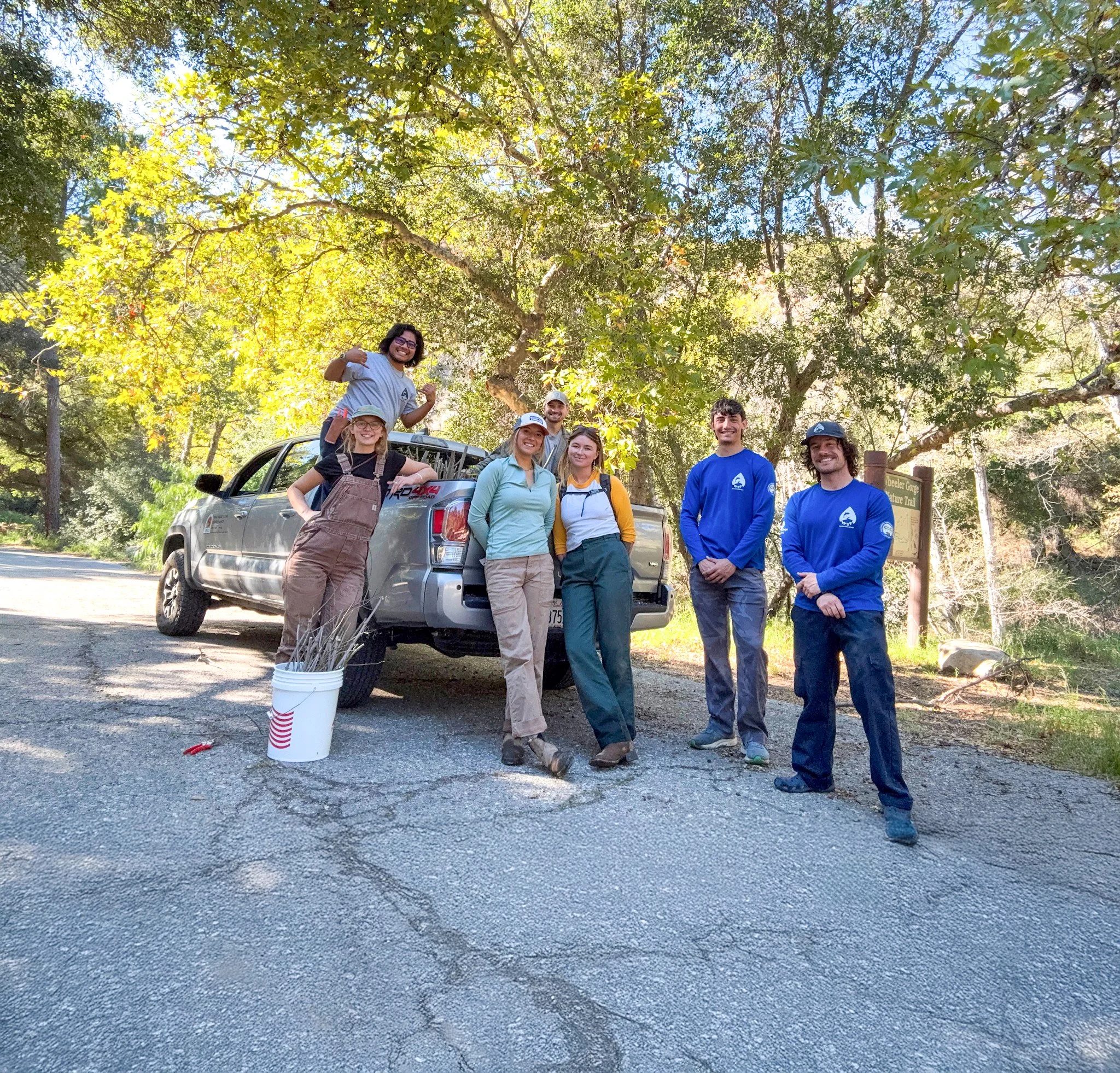
WSP Corpsmembers Dylan Hansen and Alex Dixon with OVLC’s restoration team at Wheeler Gorge Campground, preparing for a day of habitat restoration to improve fish passage on the North Fork of Matilija Creek.
HOW WSP IMPACTS THE VENTURA RIVER WATERSHED
Southern California steelhead trout populations have significantly declined over the past half-century and were listed as endangered under the ESA in 1997. Until the mid-20th century, Ventura and Santa Barbara counties supported world-class steelhead fisheries, with runs of thousands of fish each year. However, from 1994–2018, only 177 observations were recorded.
These declines are due to a variety of factors, including channelization of waterways, fish passage barriers such as dams and road crossings, water pollution, and climate change. Together, these impacts have limited steelhead’s ability to spawn successfully, resulting in a dramatic population decline.
The disappearance of a keystone species in Southern California waterways has created ripple effects across riparian and upland ecosystems. Without healthy annual steelhead runs, watersheds lose a critical source of nutrients and energy. Plants, animals, insects, and birds all depend— directly or indirectly—on steelhead returning to the watershed. Without them, ecosystems are missing a vital piece of nature’s complex and interconnected web.
By preserving and restoring riparian habitat to support steelhead recovery, OVLC helps rekindle these ecological connections across trophic levels and biological communities in the Ojai Valley. The Ventura River Watershed, like many others in Southern California, requires extensive restoration to support the return of healthy steelhead populations.
Through ongoing monitoring and restoration efforts—led in part by WSP Corpsmembers—there is hope to reverse constraints on watershed function, improve climate resilience, and enhance habitat conditions to ensure survival and recovery of Southern California steelhead trout.
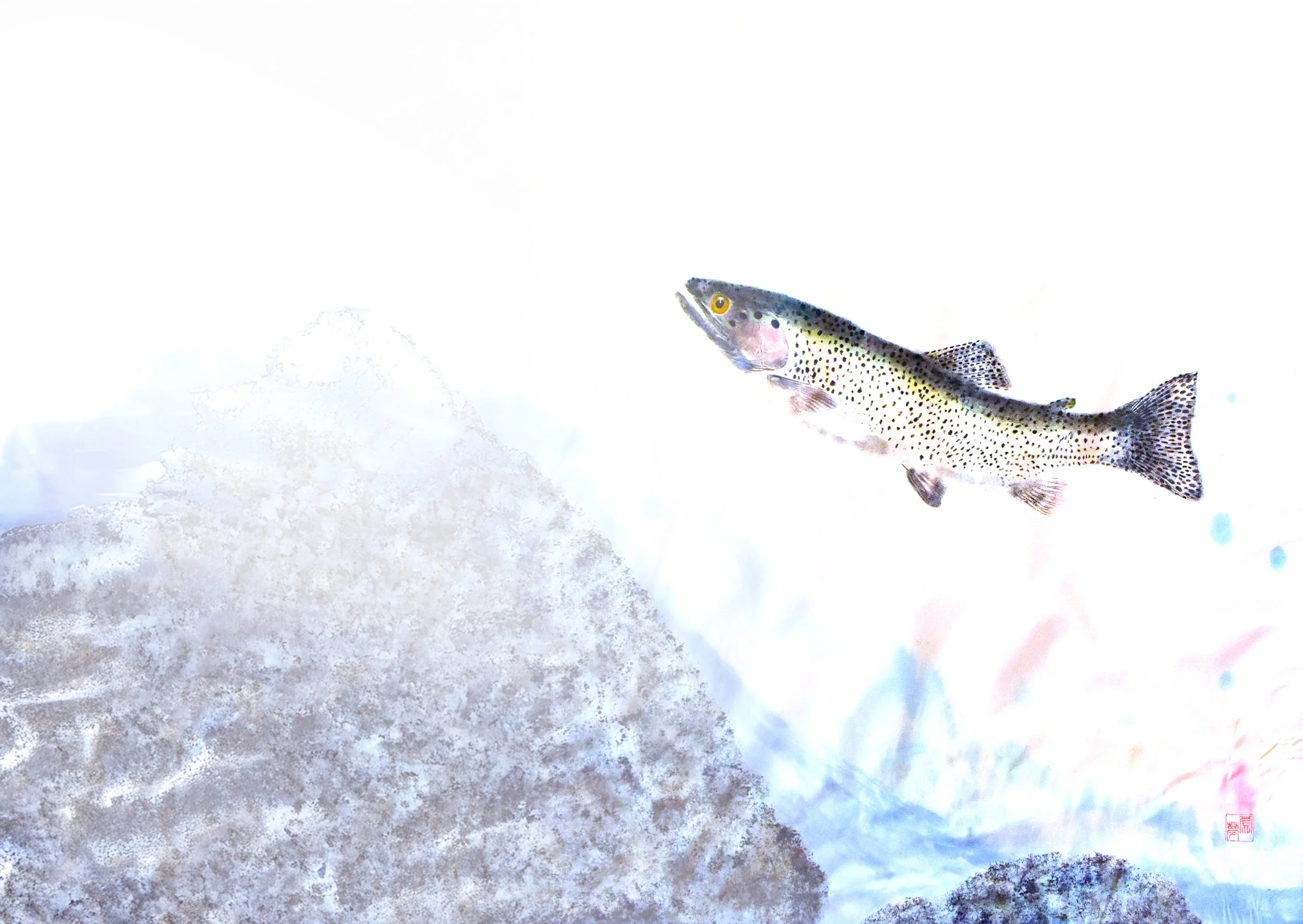
Artwork by Tom McCormick